Showing posts with label Innate Immune System. Show all posts

Neutrophils

Author: V. Dimov, M.D., Allergist/Immunologist and Assistant Professor at University of Chicago
Reviewer: S. Randhawa, M.D., Allergist/Immunologist and Assistant Professor at NSU

Neutrophils, also called polymorphonuclear leukocytes (PMNs), are the most abundant circulating WBCs. PMNs mediate the earliest phase of inflammatory response.

Granulocytes are CD45+ CD15+ cells.

PMNs migration to tissues

CXCL8 (IL-8)
forms a chemotactic gradient that directs leukocytes towards site of tissue injury/infection. Neutrophils are activated by cytokines secreted by Th17 cells.

Neutrophils migrate into tissues via:

- IL-8
- LTB4
- IFNγ
- f-met-leu-phe (fMLP)
- C5a
- interactions between Sialyl-Lewis X, P-selectins and LFA-1/ICAM-1
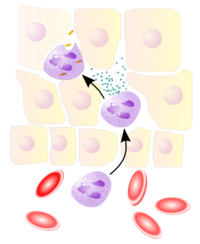

Neutrophils extravasate from blood vessels to the site of tissue injury or infection during the innate immune response. Image source: Wikipedia, GNU Free Documentation License.

What is the PMN half-life?

6 hours. 100 trillion cells are produced every day by the BM.

What is the most important PMN enzyme?

Elastase.

PMNs do not stain either red (eosinophils) or blue (basophils).

Video: A neutrophil chasing bacteria, set to music. Phagocyte immunodeficiencies (click to enlarge the image): References Phagocyte deficiencies
Published: 06/28/2010
Updated: 07/16/2012

Neutrophil actin dysfunction

Author: V. Dimov, M.D., Allergist/Immunologist and Assistant Professor at University of Chicago
Reviewer: S. Randhawa, M.D., Allergist/Immunologist and Assistant Professor at LSU (Shreveport) Department of Allergy and Immunology

Neutrophils and other phagocytes migrate to the site of infection, ingest pathogens, and destroy them after releasing granule contents and active oxygen. These activities are closely associated with a rapid reorganization of the cytoskeleton, in which actin polymerizes, cross-links, anchors to the membrane and depolymerizes under the control of various actin-associated proteins.

Defect in actin results in neutrophil cytoskeletal disease where abnormality primarily appears as motility or chemotactic defect of the cells.

The first case of neutrophil actin dysfunction (NAD) was reported in 1974, a male infant with a severe neutrophil motility disorder and poorly polymerizable actin in PMN extracts. NAD is associated with a true defect in PMN actin assembly and is a genetic disorder that is recessively inherited.

Which of the the following conditions is associated with impaired phagocytic uptake:

(A) neutrophil actin dysfunction
(B) cyclic neutropenia
(C) hyper-IgM syndrome
(D) CVID
(E) IgA deficiency
(F) Kostmann' syndrome, severe congenital neutropenia (SCN)

Correct answer: A

References

Neutrophil actin dysfunction is a genetic disorder associated with partial impairment of neutrophil actin assembly in three family members. F S Southwick, G A Dabiri, and T P Stossel. J Clin Invest. 1988 November; 82(5): 1525–1531.
Neutrophil Cytoskeletal Disease. International Journal of Hematology, 2001.

Published: 05/09/2010
Updated: 05/09/2010