Author: V. Dimov, M.D., Allergist/Immunologist and Assistant Professor at University of Chicago
Reviewer: S. Randhawa, M.D., Allergist/Immunologist, Fort Lauderdale, FL
A 38-year-old male is at the allergy clinic here for evaluation of low CD4 count. The reason for checking his CD4 was that he volunteered to be involved in a research project 5 years ago. His absolute CD4 was 456 at the time. At that time, he was negative for both HIV-1 and HIV-2 type viruses, and the test was repeated in 3 years later. Since then, his CD4 count continues to be low. It was 432 three years ago. Despite the low CD4 count, however, he has no history of any infections or abnormalities related to it. He has history of difficulty gaining immunity against hepatitis B after vaccination, and after 3 separate vaccinations, he was not able to develop detectable IgG antibody against it. His flow cytometry from 3 years ago showed absolute CD4 count of 432, CD8 count of 379, CD19 count of 261, and CD56 count of 278. He had positive immunoglobulin G against measles and rubella 10 years ago. He does not recall any family history of immunodeficiency. He has no family history of allergic rhinitis, asthma or eczema or food allergy.
Past Medical History: As above. Past Surgical History: Negative. Current Medications: He is not on any medications on a regular basis. Family History: Unremarkable. Physical Examination: unremarkable.
What is the most likely diagnosis?
Idiopathic CD4 lymphocytopenia of unclear etiology at this point.
Any clues about the etiology of his idiopathic CD4 lymphocytopenia?
A variety of past or latent viral diseases can induce CD4 lymphocytopenia. Autoimmune conditions can also pay a role. In patients with asymptomatic CD4 lymphocytopenia in the absence of HIV infection and opportunistic infections, a genetic defect could be the cause.
What laboratory workup would you suggest?
Evaluate the function of the other parts of his immune system including B cells and T cells and humoral immunity.
Regarding his idiopathic CD4 lymphocytopenia, the suggested workup would include flow cytometry with CD4, CD3, CD8, CD19, CD26, CD56, and CD16, also immunoglobulin G subclasses, immunoglobulin G, A, M, and E, CBC with differential, immunoglobulin G titers for 23 pneumococcal serotypes, tetanus, diphtheria, hepatitis, and mumps, and also mitogen stimulation test for lymphocyte proliferation for B and T cells.
ANA, CMP, ESR and UA can also be addded to his laboratory work.
An evaluation by an infectious disease specialist for his lymphocytopenia is also suggested in order to rule out any latent viral infection that may play a role in his etiology.
Published: 06/12/2011
Updated: 08/23/2011
Showing posts with label T Helper Cells. Show all posts
Showing posts with label T Helper Cells. Show all posts

T Helper Cells
Author: V. Dimov, M.D., Allergist/Immunologist and Assistant Professor at University of Chicago
Reviewer: S. Randhawa, M.D., Allergist/Immunologist and Assistant Professor at LSU (Shreveport) Department of Allergy and Immunology
CD4 T cells make 60% of circulating T cells. CD4 T cells are cytokine-secreting helper cells. They recognize antigens only through MHC II -- the antigen has to be ingested and degraded by antigen-presenting cells (APC) and presented on the cell surface via MHC II molecules.

Schematic representation of MHC class II. Image source: Wikipedia.
MHC Class II Processing. This video describes the assembly of MHC Class II molecules. This video is from: Janeway's Immunobiology, 7th Edition, Murphy, Travers, & Walport. Source: Garland Science.
The CD4 molecule is a protein of the immunoglobulin superfamily. The HIV virus binds to CD4 via its gp120 and therefore is has a special predilection for infecting CD4 cells.

Diagram of HIV. Image source: Wikipedia.
CD4/CD8 ratio is a sensitive marker to predict HIV infection in infants. Shearer et al. analyzed HIV-exposed infants and found that a CD4/CD8 ratio of 1.8 or less at 3 months of age was more sensitive than CD4+ T-cell counts to predict HIV infection. This finding may be useful to help HIV diagnosis in poorer countries without access to virology laboratories.
Th1 and Th2 Cells
CD4 helpers are divided into Th1 and Th2 subsets. The differentiation into Th1 or Th2 is driven by cytokines (IL2, IL4) which upregulate STAT molecules (signal transducers and activators of transcription).
Th1
Th1 cells participate in cell-mediated immunity (delayed type hypersensitivity reactions and killing of intracellular
pathogens), autoimmune diseases (e.g. RA, MS).
Th2
Th2 cells participate in humoral immunity via activation of B cells. They play an important role in allergic inflammation (e.g. asthma, allergic rhinitis) via activation of mast cells andeosinophils. Th1/Th2 bias is a term which describes whether Th1 or Th2 response is predominant.
Th
I
Infection
Intracellular pathogens
Immune diseases, i.e. autoimmune diseases
Inflammatory bowel disease (IBD)
Th2
Antibodies, i.e. humoral immunity
Allergy
Asthma
Allergic rhinitis

Th1 and Th2 subsets (mind map)
Early childhood immunizations have been viewed as promoters of asthma by:
- stimulating a TH2-type immune response
- decreasing "microbial pressure," thus shifting the balance between TH1 and TH2 immunity
Number of CD4 T cells /mcL is different in children and adults
Adults, older than 18 years
More than 500
Children - depends on age
0-1 year
More than 1500
1-5 year
More than 1000
6-12 year
More than 500
The hygiene hypothesis
Decreased atopic sensitization associated with living in a farm was explored by studying bacteria found in cowsheds. Acinetobacter lwoffii and Lactococcus lactis shifted the immune response toward the secretion of TH1 cytokines in a murine model. One begins to wonder if biotherapy with bacterial extracts would be in the future of studies of allergy prevention.
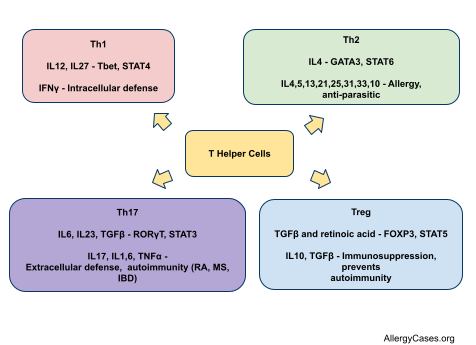
T helper cells (click to enlarge the image).

Regulatory T cells - 6 groups have been described as of year 2010 (click to enlarge the image).
Published: 06/28/2010
Updated: 08/16/2010
Reviewer: S. Randhawa, M.D., Allergist/Immunologist and Assistant Professor at LSU (Shreveport) Department of Allergy and Immunology
CD4 T cells make 60% of circulating T cells. CD4 T cells are cytokine-secreting helper cells. They recognize antigens only through MHC II -- the antigen has to be ingested and degraded by antigen-presenting cells (APC) and presented on the cell surface via MHC II molecules.

Schematic representation of MHC class II. Image source: Wikipedia.
MHC Class II Processing. This video describes the assembly of MHC Class II molecules. This video is from: Janeway's Immunobiology, 7th Edition, Murphy, Travers, & Walport. Source: Garland Science.
The CD4 molecule is a protein of the immunoglobulin superfamily. The HIV virus binds to CD4 via its gp120 and therefore is has a special predilection for infecting CD4 cells.

Diagram of HIV. Image source: Wikipedia.

CD4/CD8 ratio is a sensitive marker to predict HIV infection in infants. Shearer et al. analyzed HIV-exposed infants and found that a CD4/CD8 ratio of 1.8 or less at 3 months of age was more sensitive than CD4+ T-cell counts to predict HIV infection. This finding may be useful to help HIV diagnosis in poorer countries without access to virology laboratories.
Th1 and Th2 Cells
CD4 helpers are divided into Th1 and Th2 subsets. The differentiation into Th1 or Th2 is driven by cytokines (IL2, IL4) which upregulate STAT molecules (signal transducers and activators of transcription).
Th1
Th1 cells participate in cell-mediated immunity (delayed type hypersensitivity reactions and killing of intracellular
pathogens), autoimmune diseases (e.g. RA, MS).
Th2
Th2 cells participate in humoral immunity via activation of B cells. They play an important role in allergic inflammation (e.g. asthma, allergic rhinitis) via activation of mast cells andeosinophils. Th1/Th2 bias is a term which describes whether Th1 or Th2 response is predominant.
Th
I
Infection
Intracellular pathogens
Immune diseases, i.e. autoimmune diseases
Inflammatory bowel disease (IBD)
Th2
Antibodies, i.e. humoral immunity
Allergy
Asthma
Allergic rhinitis

Th1 and Th2 subsets (mind map)
Early childhood immunizations have been viewed as promoters of asthma by:
- stimulating a TH2-type immune response
- decreasing "microbial pressure," thus shifting the balance between TH1 and TH2 immunity
Number of CD4 T cells /mcL is different in children and adults
Adults, older than 18 years
More than 500
Children - depends on age
0-1 year
More than 1500
1-5 year
More than 1000
6-12 year
More than 500
The hygiene hypothesis
Decreased atopic sensitization associated with living in a farm was explored by studying bacteria found in cowsheds. Acinetobacter lwoffii and Lactococcus lactis shifted the immune response toward the secretion of TH1 cytokines in a murine model. One begins to wonder if biotherapy with bacterial extracts would be in the future of studies of allergy prevention.
T helper cells (click to enlarge the image).
Regulatory T cells - 6 groups have been described as of year 2010 (click to enlarge the image).
Published: 06/28/2010
Updated: 08/16/2010
Subscribe to:
Posts (Atom)